Since the last progress update we have made a lot of progress. Firstly, we researched the extrinsic muscles of the hand that are responsible for finger movement. We created a table that covered all of the necessary information, which would allow for more precise placement of electrodes and thus better data gathering. We have gotten Matlab to work, using code that we found online. The code forms a graph from the data that comes in through Arduino, and we saved the numerical values. We have been recording data from the extensor digiti minimi because it is the only muscle that we could find that was both superficial and responsible for only one muscle movement. We recorded each finger's extension from that muscle with the hopes of finding a pattern or seeing how much interference is involved. After recording the data in each finger, we found the maximum points from each finger extension, and then found the average value of that maximum EMG reading, which we did in Excel.
Some problems we encountered were what to save the Matlab workspace as, since we saved it as a .mat rather than a .m. Another problem we have encountered is that a lot of the muscles that are clearly defined as affecting only one finger are deep muscles, meaning it will be harder to record data. Another problem is that certain fingers don't have a unique muscle that we can measure. We also are limited by the fact that we have only one recorder for EMG signals, since we only can record one channel at a time.
Our goals are to figure out which finger we are going to record next, and also to do some coding in Matlab to try and cut down on the amount of time that it takes to get the maximums from Matlab automatically.
Tuesday, February 9, 2016

Monday, December 28, 2015
From Arduino to MATLAB

EMG signals acquired by the SpikerShield and Arduino Uno can be send to the Macbook Air through serial port (USB). The current problem is how can we read and even display the data from MATLAB. After trying a few possible solutions from the internet. There are two working solutions you can base on for your next-step development:
- Serial Monitor (Debugger): It can be downloaded from http://www.mathworks.com/matlabcentral/fileexchange/45839-serial-monitor--debugger-. It is an app that you can install, and then run it by clicking the APPS tab -> MY APPS -> Serial_Monitor. It will show the serial data in a pop-up window. You can save the data to the "SerialData" variable for further processing.
- Real Time Serial Data Logger: It's a piece of code that you can run in the MATLAB. It can be copied from https://billwaa.wordpress.com/2013/07/10/matlab-real-time-serial-data-logger/. You can just copy and paste it into the MATLAB, and a pop-up Serial Data Log window will appear to show the plotted serial data.
The followings are the screen shots and videos of these two solutions in action.
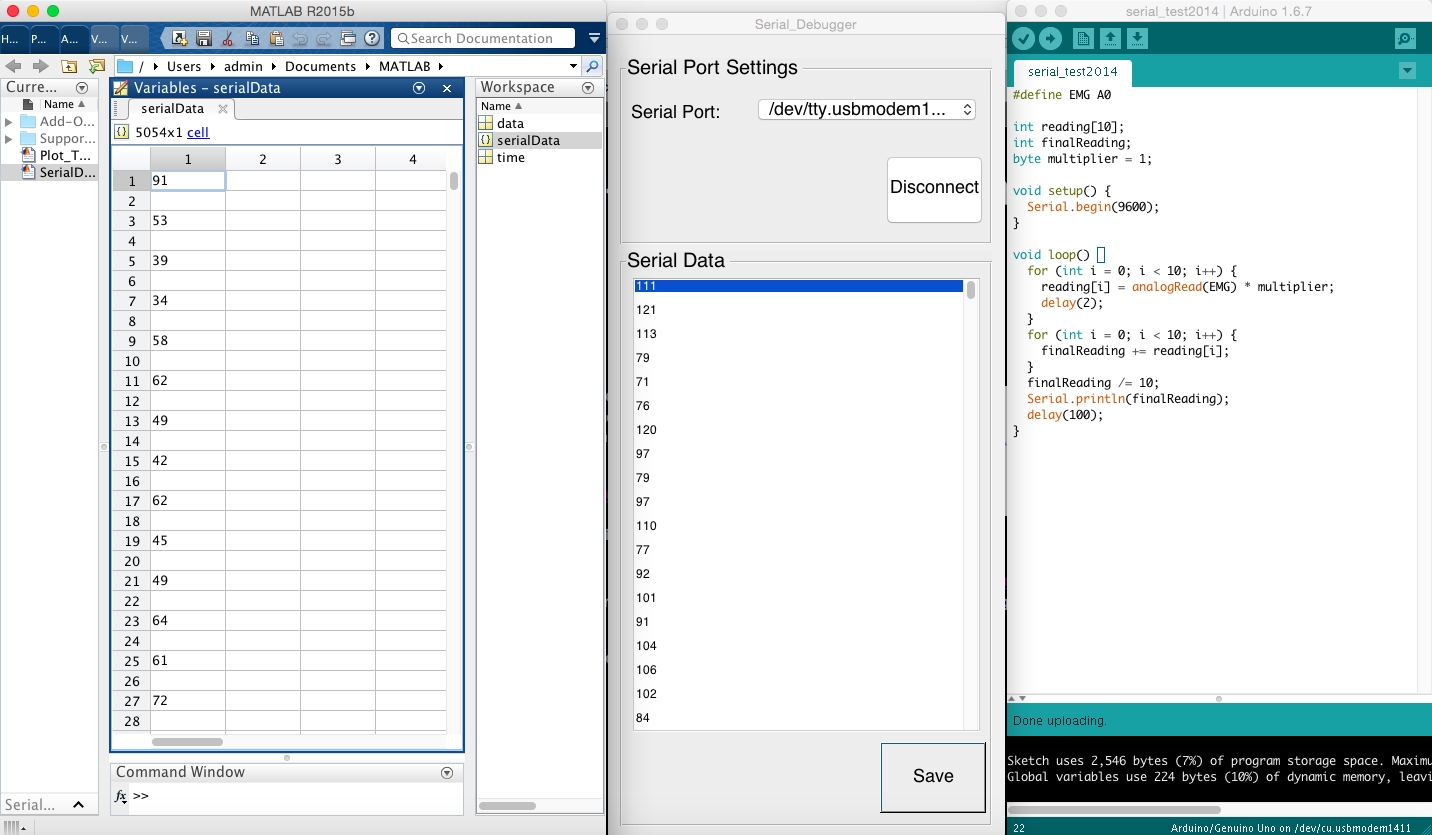 |
| Serial Monitor (Debugger) |
 |
| Serial Data Logger |
Finger Gestures vs. EMG Electrode Placement
 Congrates to be able to gather raw EMG data from the SpikerShield! While you are picking up MATLAB, we also need to figure out the EMG electrode placement as soon as possible such that we can start acquiring meaningful data. There are three documents in our the Project Resource page, which potentially provide us the info we need.
 - Finger Motion Decoding Using EMG Signals Corresponding Various Arm Postures (2010), Kyung‐Jin You, Ki‐Won Rhee and Hyun‐Chool Shi
- Relating Forearm Muscle Electrical Activity To Finger Forces (2014), Jennifer Keating. [page 22-23, 62-84]
- Forearm Muscle Labels.
The simple questions we want to start with are: "In order to detect the movement (bending and stretching the finger) of individual finger,
- what are the most important muscle(s) related to the movement (bending and stretching) of individual fingers?
- How many electrodes (or electrode pairs) do we need? And,
- where should we place those electrodes (or electrode pairs)?"
Can your team look into them, extract useful info, and summarize the results into two tables (bending and stretching)? The tables should at least consist of the following columns: Finger, Muscles (names & symbols), Category (deep or superficial), Type (extension or flexion), Location (anterior or posterior), Electrode Placement (labels matching the diagrams), and Comments.

The exact electrode placement (position and orientation) should be
labeled and indicated in the following tow diagrams (anterior view & posterior view) and matching the electrode placement in the tables.
 |
| Forearm muscles of anterior compartment: superficial, middle, and deep |
 |
| Forearm muscles of posterior compartment: superficial, middle, and deep |
You can contact me through email/blog whenever you have any question. Don't forget to post your results onto your blog and we will discuss our next step (data acquisition) based on the results after the break.
Tuesday, December 22, 2015
Progress Report: 11/30/15
We were having a lot of trouble getting MATLAB to work on the school computer, but we managed to download it onto one of our computers. In addition, we have figured out how to gather data on Arduino. We then plotted it using the spreadsheet application on Google Drive. The picture below is just a proof of concept to show that we can gather data. The values are a sign of strength of muscle movement, and each data point is collected every 100ms. The graph is for a very long time, being about 16 and a half seconds.
 Some problems we faced this week were getting Matlab to connect to Arduino on the computer to which we downloaded Matlab. For some reason it didn't work. Another problem we encountered was understanding Matlab, as looks like we will have to gain an understanding of coding and algorithms.
The plan for us is to do isolated tests of each finger for a much shorter period of time. We will repeat a specific motion, targeting a specific muscle, and through this, hopefully we will be able to identify patterns through this approach. We also hope to gain a better understanding of how to use Matlab through tutorials. We will also try to learn some coding in Arduino, although it looks like this will not be as necessary as previously thought. We have made some progress this week, we feel, and are excited to continue.

The plan for us is to do isolated tests of each finger for a much shorter period of time. We will repeat a specific motion, targeting a specific muscle, and through this, hopefully we will be able to identify patterns through this approach. We also hope to gain a better understanding of how to use Matlab through tutorials. We will also try to learn some coding in Arduino, although it looks like this will not be as necessary as previously thought. We have made some progress this week, we feel, and are excited to continue.
Sunday, December 6, 2015
STEM Patent Research: 11/30/15
An excellent list of patents, and nice summary and analysis. Based on your description in "PLACES WE CAN INNOVATE", you might want to look further into a field called Functional electrical stimulation (FES) or NeuroMuscular
Electrical Stimulation (NMES).
Tuesday, December 1, 2015
STEM Patent Research: 11/30/15
PROCESSING EMG:
Assessment of EMG signal acquired from parts of the
body where there is a lot of activation of muscles involved in motor skills
(ability to do complex muscle and nerve act to produce movement). It can
compare the pattern observed to known patterns obtained during a controlled
activity.
The invention is a circuit that can take EMG signals
and transfer them via USB to a computer.
A way and apparatus that can be used to produce a
model EMG signal from a measured one by a series of filters. The EMG signal
that results is separate from the EMG and EKG signal that is measured.
EMG signals are detected from several different
locations on the hand. These locations of electrodes are where precise
movements occur. The EMG signals are registered and processed to be used for
biometric assessment.
Acquiring uterine EMG signals. Signal processing
device transmits the signal to a relaying device which sends it out to a call
center for a doctor to look at. Can potentially help us figure out how to
transmit the signal to another arm etc. At least one pair of electrodes used.
ANALYZING EMG:
A machine learning model that has the user do specific
gestures so that it learns the signals from that gesture. The machine learning
model can then identify specific gestures from specific fingers of the user
using the information that it has learned.
A sensing device that allows patients to control an
object by using motor unit action potential. It uses an emg sensor which they
place on a specific area of the patient. It also configures a signal that
represents the motor unit action potential. Then it uses a personal area
network transmitting device that corresponds to a specific signal.
Personal area network is used to convert it to an electrical signal which then
goes through a processor where the electrical signal is received to generate at
least one control signal.
GADGETS TO HELP HUMANS:
Hybrid prosthetic arm controlled by surface EMG
(determines electrical activity of the muscle) (sEMG places electrodes on the
skin overlaying the muscle and not INTO the skin) and mechanical control from
elbow and shoulder of amputee. Device contains mechanical fingers driven by
mechanical motors controlled by microcontrollers (a small computer (SoC) on a
single integrated circuit containing a processor core, memory, and programmable
input/output peripherals.) The instruction sent to the arm is from sEMG
signals. It can convert sEMG data into instructions, and movement comes from
motion of the shoulder, rotation of the elbow, and sEMG signal.
A lower prosthetic limb that uses EMG signals to
determine the user’s specific gait phase. The device recognizes which EMG
signals correspond with which type of locomotion to better replicate the user’s
motion.
An athletic glove that records EMG signals from
electrodes on the inside of the glove. The data is gathered and processed, and
then output on an external module of the glove. This data provides feedback on
grip to the user.
TENS bandage that uses electrical stimulation to
ease and block pain within wounds. Also helps with healing of a wound.
A suit that has electrodes placed on it. Wires
connect the electrodes together with a form of stimulation device. The wearer
or user can apply electrical stimulation to certain muscle groups or parts of
the body, inhibiting a response.
STIMULATION:
Stimulating nerves using electrodes with an
electrically insulating back layer. Increases electrical current through
surrounding tissues. Increases impedance of electrical path through blood in
lumen of blood vessel.
A surface probe with a conductive tip that can apply
a local high voltage. The electricity applied causes a stimulation of the
targeted muscle fibers, eliciting a forceful movement from those muscles. The
force and number of twitches can be altered.
A device that can send electrical stimulation to the
extremities specifically. It braces the hands in place on a flat surface and
then provides the shock with a TENS unit.
An automated system that is able to deliver
electrical stimulation to the user. It can then also detect the muscle response
from the electrical stimulation. Being able to detect muscle response and
deliver electrical shocks, the system is able to automatically diagnose one
characteristic of a muscle from the response and adjust the electrical
stimulation accordingly.
A TENS device that is able to apply electrical
stimulation to muscles and also detected changes in the skin. There are two
modes, stimulation mode and re-calibration mode. Via a plurality of electrodes,
the device can apply an adjusted electrical current to the user based on skin
impedance.
A device that contains a pulse generator to mimic
MUAPs that are naturally generated. The invention can synthesize the basic wave
form, not depending on muscle contraction to achieve any form of stimulation.
A TENS unit can connect to a smartphone via
bluetooth. It can receive data as far which signals to transmit, and it can
also send data to the smartphone in response to biofeedback from the user’s
body. The controller can change pulse width, frequency, and/or intensity.
PLACES WE CAN INNOVATE:
The devices of EMG and TENS remain generally
separate in the patents that we found. Both technologies seem to be known, it
is just a matter of finding a method of combining these technologies. One place
we can innovate is in a device that integrates both technologies together.
Another area that we can innovate is in TENS. Some
of the patents that we found were able to adjust the signal, like in frequency
or intensity. We could find a way to develop a TENS unit that can accept a
changing signal and shock the user with that type of signal.
Friday, November 27, 2015
Virtual Reality Application

Subscribe to:
Posts (Atom)